This website use cookies to ensure you get the best experience on our website
About Us
I've been working in UK manufacturing for about a decade but coming into it with a fresh pair of eyes, it was clear in my first year or so that something rather weird was going on in the decision making which i couldn't put my finger on.
There seemed to be an underlying obsession to cut costs but a reluctance to make more products. I thought this was just a one-off due to early exposure in manufacturing but I couldn't have been more wrong...
95%+ of the manufacturing companies I have visited or dealt with in the UK focus on the wrong areas: spending millions optimising non-bottlenecks, trying to perfect spaghetti maps, or worst-still... about to implement OEE!
The willpower is there however - companies want to succeed but basic improvement decisions take forever and accountant spreadsheets now call the shots.
Technology is more sophisticated than ever, but we are failing at the basics and due to the lack of inherent focus built into Lean & Six Sigma (great tools when used well) this has just compounded chaos and confusion.
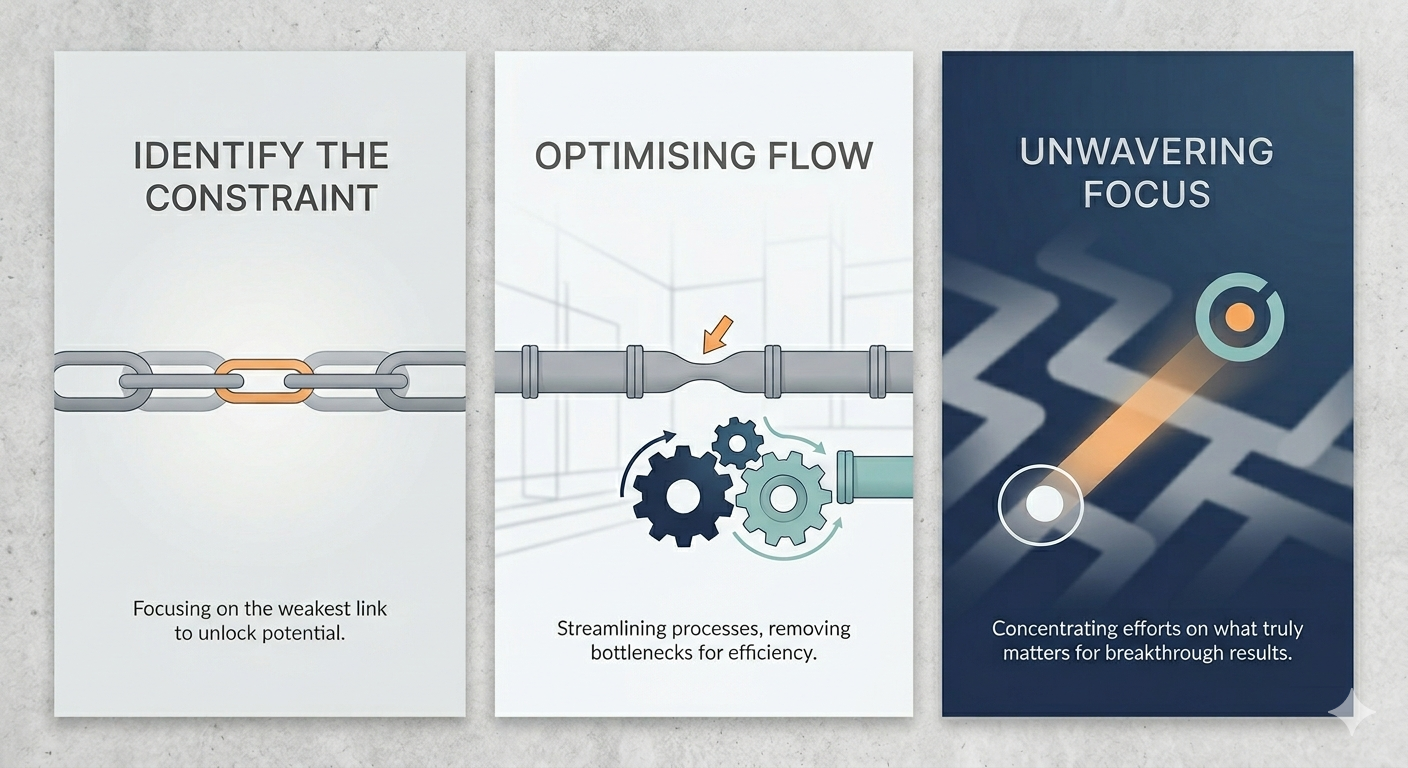
I have built this site to help UK manufacturing better focus and hopefully become stronger mainly by helping remove obscurity on Theory of Constraints (TOC) and concise, practical applications in real-working manufacturing.
The Mission
I believe UK Manufacturing has lost its focus and (poor) cost-accounting decisions are now strongly embedded in our culture. Compared to other countries like China or USA etc. our resources are very limited so we have to manufacture smart to keep ahead and reduce external reliance.
The mission is not yet crystal-cut but the outline is as such across the next 5-10 years:
1. Reduce obscurity with TOC (& use with Lean & Six Sigma) by building a more modern knowlegde base via:
- Blog posts
- Videos
- Training
- Discussions
2. Help build a strong UK-focused TOC network
3. Support sustainable UK businesses to achieve breakthrough results (Viable Vision)
Given the power of TOC and global factors faced, it is clear that sustainability must be considered and this raises interesting ethical issues I want to also further align on as a group.
Practically, if this activity enables even 1 x sustainable UK company to prevent closure and achieve radical improvements, I will consider it a success.
This mission is nothing new. Japan in the 1950s (after WW2) was renowned for poor-quality manufacturing, but with a focused mind shift change, by the 1970-80s it was, and still is, considered a manufacturing powerhouse. This shows that just a few driven people and companies can benefit a whole country for generations.